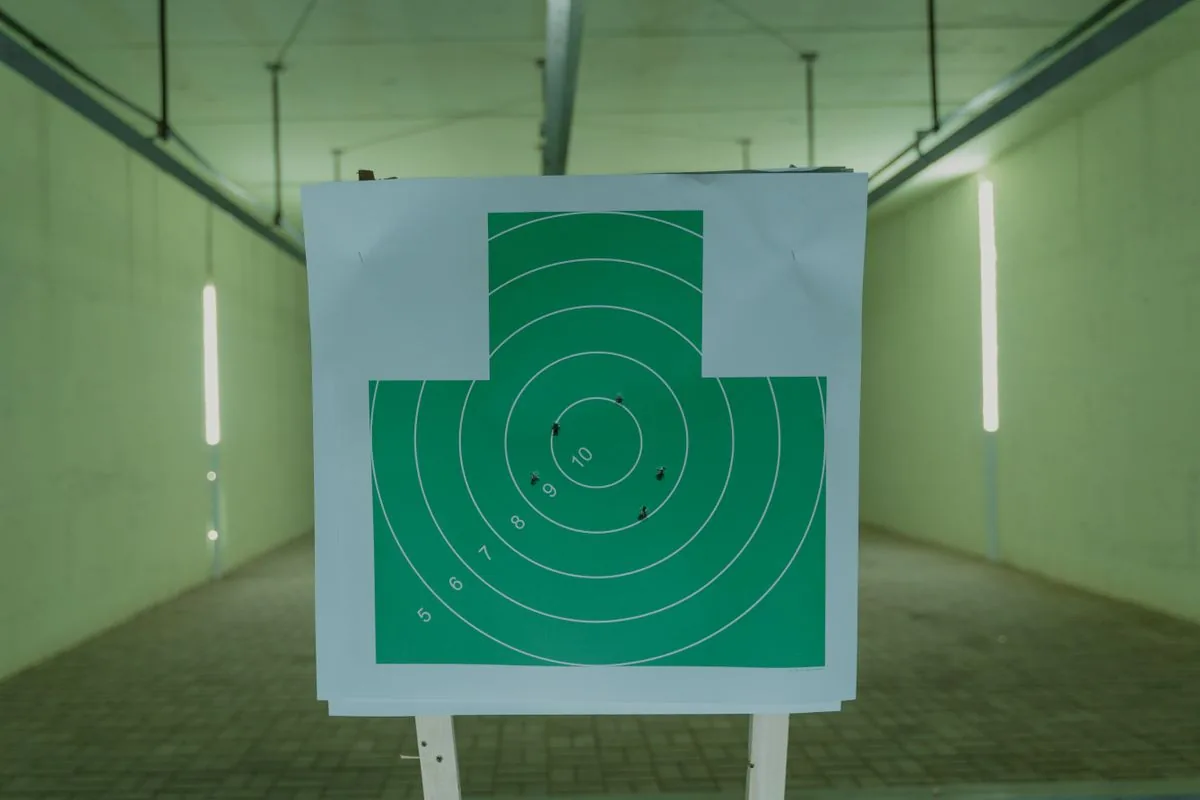
A target is a feedback sheet, and learning how to read a target, whether your shots string vertically, horizontally, or scatter round, points you toward whether your ammunition or your technique deserves the next hard look. This guide walks through what each pattern usually means and how to chase down the cause.
In this guide
- First: shoot enough rounds
- Vertical stringing
- Horizontal stringing
- Round groups
- Don’t over-read a flyer
- Load vs technique
- Read it precisely
First: shoot enough rounds
Before you diagnose anything, shoot enough to have a real pattern. A three-shot “string” is usually just noise: random dispersion can look like a neat line by chance. Five rounds is a sensible minimum, and ten tells you far more. Reading patterns into tiny groups is the fastest way to fix a problem you do not have.
Vertical stringing (shots up and down)
Vertical is the long-range shooter’s enemy, and at distance it is most often a velocity problem: inconsistent muzzle velocity (high SD/ES) makes some rounds land high and some low. If your vertical grows with distance, look hard at your velocity spread first: see what is a good SD for reloading and what the evidence on velocity nodes actually shows. Closer in, vertical is more often technique: inconsistent shoulder or bipod pressure, breathing, natural point of aim, or follow-through.
Horizontal stringing (shots left and right)
Horizontal dispersion outdoors is usually wind first and foremost: switching conditions push rounds laterally between shots. After wind, the usual suspects are shooter-induced: trigger control (jerking or pushing), rifle cant, parallax, and inconsistent grip or cheek pressure. If your verticals are tight but you are spraying left and right, look hard at the wind and your trigger press before blaming the load.
Round groups (no pattern)
A round, patternless group is simply the combined precision of rifle, load, and shooter on the day: the random scatter with no single dominant cause. Shrinking it means improving everything a little: more consistent ammo (lower SD, sorted brass), solid fundamentals, and ammunition your rifle shoots consistently. A round group is good news in one sense: nothing is obviously broken.
Don’t over-read a single flyer
A single shot well outside the group is a flyer, and how you treat it matters. If you called it, you felt the shot break badly from a flinch, a wobble, or a gust, it is fair to set it aside and note why. If it was unexplained, you cannot just delete it: it is real data about your load or rifle. The discipline is honesty. Marking an obvious called flyer is reasonable; throwing out every shot that hurts your group is lying to yourself. Over a larger sample, genuine flyers show up as a consistent rate, not a one-off you can wish away: another reason to shoot more rounds before drawing conclusions.
Telling load from technique apart
The fastest way to separate the two is to remove yourself from the equation. Shoot off a solid rest or bags in calm conditions. If vertical or scatter persists with a rock-steady setup and no wind, the load is the likely culprit. If the group tightens dramatically off bags, you were most likely the variable, and no amount of load tuning fixes trigger control. For more on precision fundamentals, the folks at 65 Guys are a good resource.
Read it precisely with LoadNode
Eyeballing “that looks a little vertical” only goes so far. In LoadNode you tag each hole on your target photo and it does the maths: size in MOA and MIL, mean radius, and point-of-impact offset, tied to the load and the velocity data behind it, so you can see whether that vertical lines up with a high SD. The photo stays on your phone, and on Pro it is also backed up to your own private cloud space so a new phone can restore it. Read the target with numbers, not hunches. Browse more reloading resources to go deeper.
Handloading is an adult activity. LoadNode is a logbook and analysis tool: it never provides load data. Always develop loads from current published data, start low, and work up safely.