Everyone quotes group size, but it might be the noisiest way to measure how a rifle shoots. The mean radius vs group size debate matters because picking the right metric means fewer rounds wasted and fairer comparisons between loads. Here is how each works and when to use it.
In this guide
- How group size is measured
- The problem with extreme spread
- What is mean radius?
- Mean radius vs group size
- CEP and R50
- How many shots do you need?
- Which should you use?
How group size is measured
“Group size” almost always means extreme spread: the center-to-center distance between the two shots farthest apart, usually quoted in inches or MOA. It is quick to measure with calipers, which is exactly why it became the standard. If you need the how-to, see how to measure group size in MOA.
The problem with extreme spread
Extreme spread has two weaknesses. First, it is defined entirely by your two worst shots: one flyer doubles it, and it tells you nothing about how the other shots clustered. Second, it grows with sample size: a 10-shot group will almost always measure larger than a 5-shot group from the same rifle, simply because more shots give more chances to catch an extreme pair. That makes it statistically noisy and unfair to compare across different shot counts.
What is mean radius?
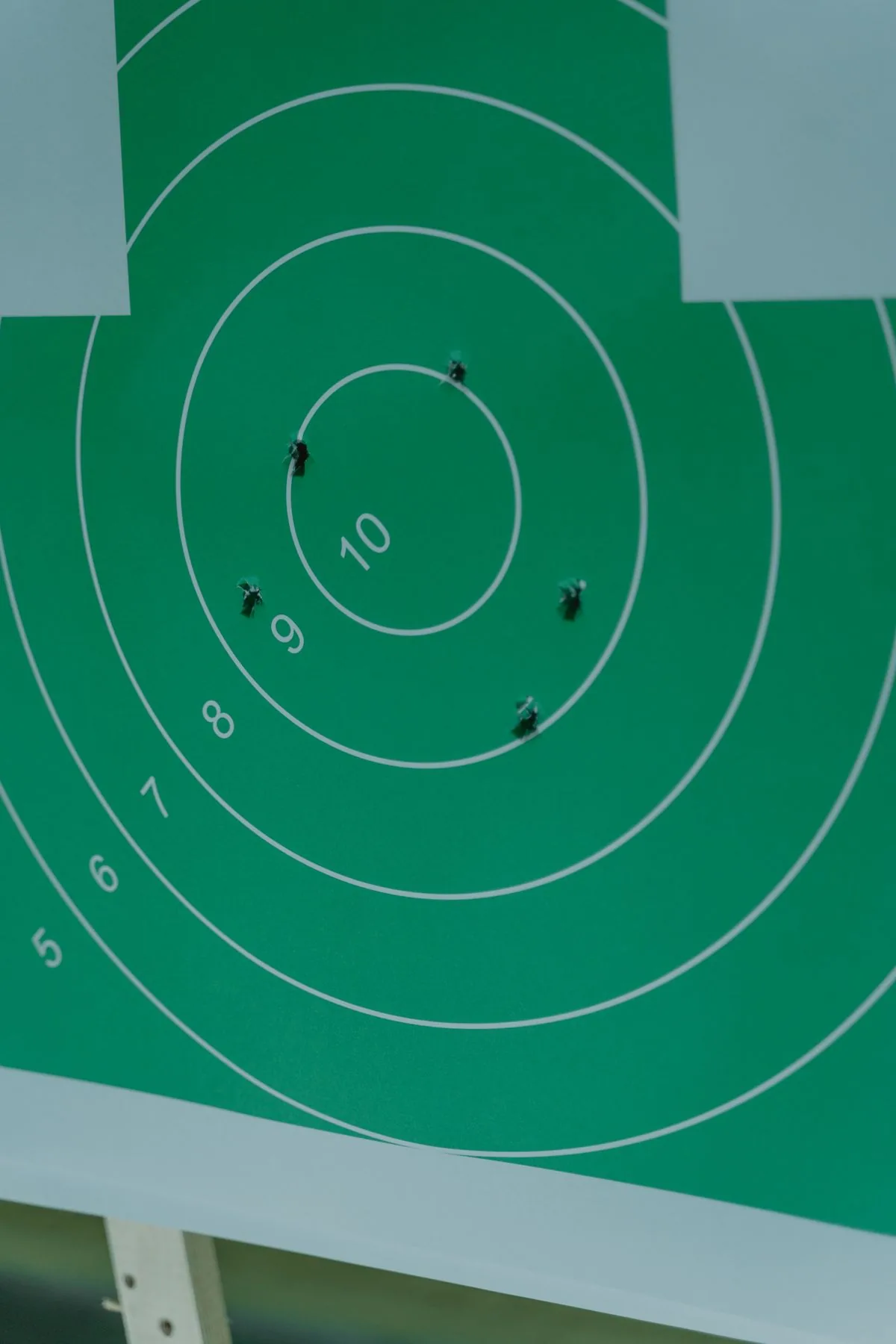
Mean radius is the average distance of every shot from the group’s center (the centroid of all impacts). Because it uses all of your data instead of just the two outliers, it is far more stable and repeatable from group to group, and it is far less sensitive to one flyer than extreme spread, which a single flyer can double. In statistical terms it is a more efficient estimator: you learn more per round fired, which is precisely what a handloader testing many charges wants.
Mean radius vs group size at a glance
| Metric | Uses | Strengths | Weaknesses |
|---|---|---|---|
| Extreme spread | 2 widest shots | Fast, caliper-friendly, familiar | Noisy; grows with shot count; ignores the cluster |
| Mean radius | Every shot | Stable, efficient, fair across sample sizes | Needs software to measure each impact |
| CEP / R50 | Every shot (probabilistic) | Robust, statistically meaningful | Less intuitive to most shooters |
What about CEP and R50?
You will also see CEP (circular error probable) or R50: the radius of a circle, centered on the group, that contains 50% of your shots (with R90/R95 variants for more). It is a probabilistic cousin of mean radius and a very honest way to express precision. If you want the formal background, see circular error probable.
How many shots do you need?
Because mean radius uses every impact, it settles down with fewer rounds than extreme spread does: at 5 or 10 shots it is already steadier than extreme spread, which would still be swinging from group to group. It is still an estimate, and at those shot counts it carries a wide interval, which is why LoadNode shows a 95% range around mean radius when it pools your groups, and lets Pro users pool a charge into a 20 to 50 shot sample instead of trusting a lucky five. That efficiency is the practical reason to prefer it during load development: you learn more per round of barrel and brass. Extreme spread, by contrast, keeps creeping upward the more you shoot, so judging a 5-shot group against a 10-shot group on extreme spread alone is comparing apples to oranges. If you only remember one thing: compare like sample sizes, and lean on mean radius when rounds are precious.
Which should you use?
For a quick caliper check or to compare against published group sizes, extreme spread is fine. For serious load comparison, where every round of barrel life counts, mean radius (or CEP) extracts more information per shot than extreme spread does. LoadNode reports both, in MOA and MIL, from a single photo of your target, and, where there are shots enough and the group is round enough for the circular model to hold, it shows the pooled mean radius as a 95% range rather than as a single number. It never ranks charges and never names a best one. Then cross-check the velocity side with a good SD.
Handloading is an adult activity. LoadNode is a logbook and analysis tool: it never provides load data. Always develop loads from current published data, start low, and work up safely.