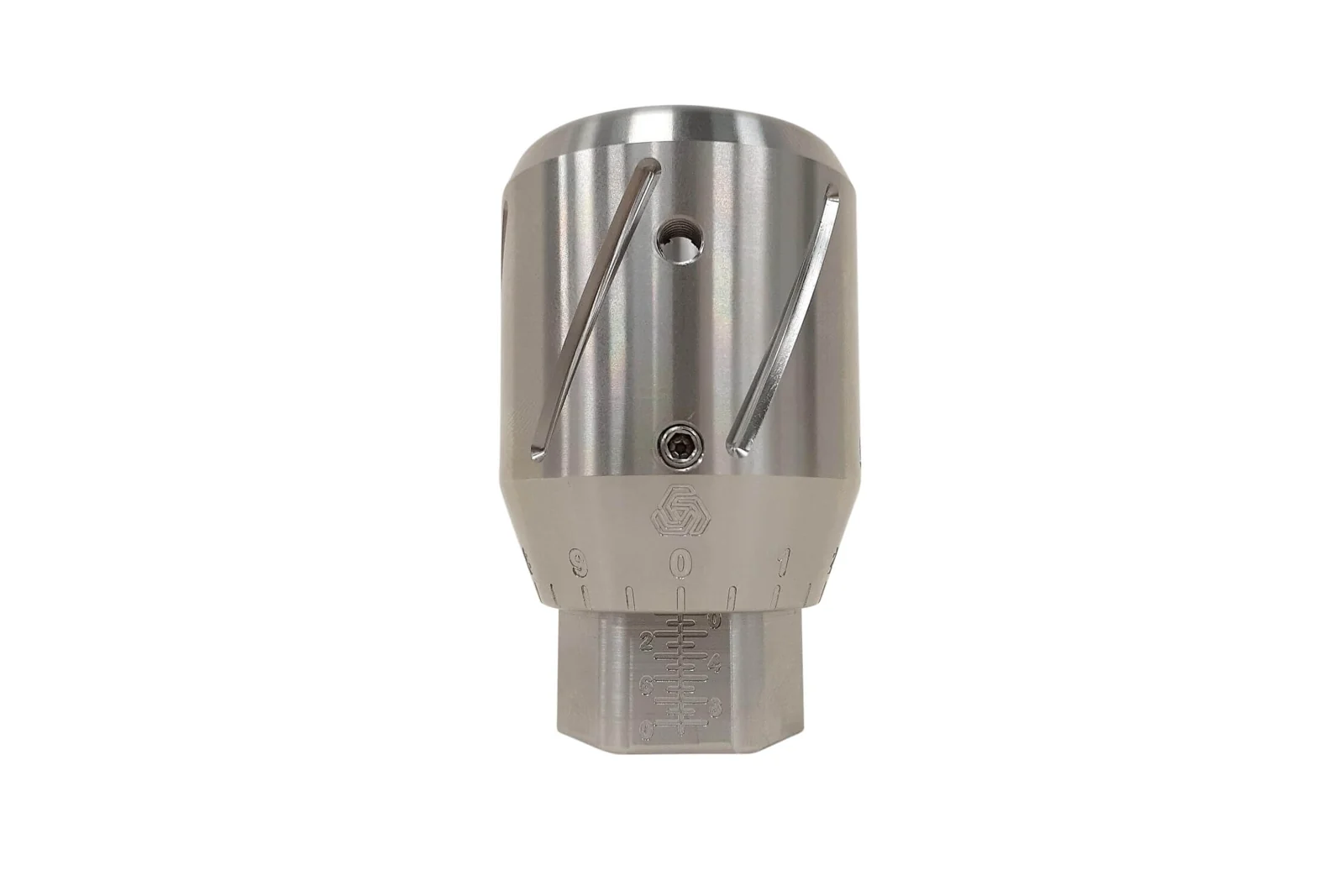
Barrel tuners attract strong opinions. Some shooters swear by them, others call them jewelry, and both camps usually argue from a handful of groups shot on one windy afternoon. Barrel tuner testing deserves better than that. A tuner is a simple, adjustable mechanical device, and whether it does anything useful on your rifle is a measurable question. It just takes a disciplined layout and more rounds than most people expect to spend.
What a barrel tuner actually does
A barrel is not a rigid bar. When the round fires, the barrel flexes and oscillates, and the bullet leaves the muzzle at some point in that motion. If the muzzle is moving at the instant of exit, the bullet departs at a slightly different angle than it would from a still barrel. Exit timing varies a little from shot to shot, and that adds to vertical dispersion. The general physics is covered under vibration, and a barrel is a fairly ordinary case of it.
A tuner is a weight, usually a threaded collar on the muzzle, that you move forward or back along the barrel. Moving mass changes how the barrel vibrates, and with it the moment in the cycle when the bullet exits. The hope is a position where exit timing sits on a flatter part of the motion, so small velocity differences matter less. It shifts timing. It does not remove vibration, and it does not fix a bad barrel, poor bedding or inconsistent ammunition.
The tuner pictured above is made by Spearhead Machine, a Canadian shop that is well respected in precision shooting for the quality of its machining and finish. Whichever tuner you run, a clear, repeatable position scale like the one on this one is what makes careful barrel tuner testing possible.
Why barrel tuner testing needs its own method
In an ordinary load test the variable is a component or a charge. In barrel tuner testing the load stays fixed and the variable is the tuner position. That is cleaner, since you are not building new ammunition at every step, but harder too, because the effect you are hunting is usually small, and position-to-position changes are easily swamped by wind, shooter error and ordinary dispersion.
So stay measured about what a tuner can do. On some rifles a real effect is plausible. On others there may be nothing to find, and a good test should be able to tell you that too.
How to lay out a barrel tuner testing session
The structure is the same as any fair comparison: change one thing, hold everything else still, and gather enough data at each step to mean something.
- Fix the load. Use one batch of ammunition, loaded from current published data, so brass, powder lot and seating are identical at every position.
- Mark your positions. Use the marks on the tuner’s scale, treat zero as a real position, and decide the step size before you start.
- Confirm zero. Check where the rifle is shooting before you move the tuner, and note the starting position.
- Shoot a group at each position. Same distance, rest and routine every time. Record velocity on every shot too, since SD at each position is useful data.
- Return to a position you already shot. A return-to-zero repeat tells you whether the rifle itself drifted during the session.
- Run a second pass. If a position looks interesting, shoot it again on another day, in a different order.
If you always step in one direction, any change in light, wind or barrel temperature gets baked into the trend and looks like a tuner effect.
Shots per position: the sample size trap
The most common mistake in barrel tuner testing is shooting three rounds at each setting and calling the smallest group the sweet spot. A three-shot group is built from two shots and has a huge variance of its own, as we cover in how many shots for load development. Shoot the same rifle with no change at all and group sizes will wander by more than the difference you are trying to find.
Use a statistic that counts every shot. Mean radius is far steadier than extreme spread. Even so, budget for a meaningful string at each position and expect the exercise to consume real barrel life. Testing fewer positions properly beats testing many badly.
The traps that produce a false tuned spot
- Wind. A crosswind changes group shape and size between strings. Shoot in calm periods and note what you could not avoid.
- Hindsight selection. With ten positions and noisy groups, one will look best by chance alone. That is the luck of the draw, not tuning.
- Barrel heat. Long strings warm the barrel and shift point of impact. Keep the cadence the same at every position.
- Loose hardware. A tuner that creeps, or a loose action screw, gives results that look like tuning and vanish next session. Check the tuner is locked at each setting.
- Changing two things. If you also touch the rest, the optic or the ammunition, you cannot say which change mattered.
Reading barrel tuner testing results honestly
Plot group size, and separately SD, against tuner position. Look for a region that stays good across neighboring positions and across repeat sessions, not a single spike. A genuine effect should look like a smooth trend with a broad minimum. One isolated tight group among ordinary ones is almost always noise.
The logic matches reading a charge ladder, where a stable plateau beats a single best point. Our comparison of a ladder test and an OCW test explains why, and the same reasoning applies to a velocity node. If your best position is no better than the untuned baseline once sample size is accounted for, that is a useful result: you have saved yourself from chasing a phantom.
Record keeping
A tuner session produces many small groups that look alike in a notebook. For each one, log the tuner position, shot count, group measurement, SD and ES, the ammunition batch, wind, temperature, and whether it repeated an earlier setting. Record the tuner itself as part of the rifle’s setup too, since a tuner moved to another muzzle device makes older results meaningless unless the configuration was written down.
LoadNode has a Tuner test type for this (Pro). Each rung is a tuner position, using the marks on the tuner’s scale, and zero is a real position. Instead of a charge axis, the chart plots SD and group size against tuner position. You can add several rungs in a row at the bench before shooting. The per-firearm parts and setup list (Pro) can hold the tuner as a part, and each session keeps its own copy of the setup. Logging cannot make a tuner work, but it keeps your barrel tuner testing honest.
Handloading is an adult activity done at your own risk. LoadNode is a logbook and analysis tool: it never provides load data. Always develop loads from current published manufacturer data and work up safely.