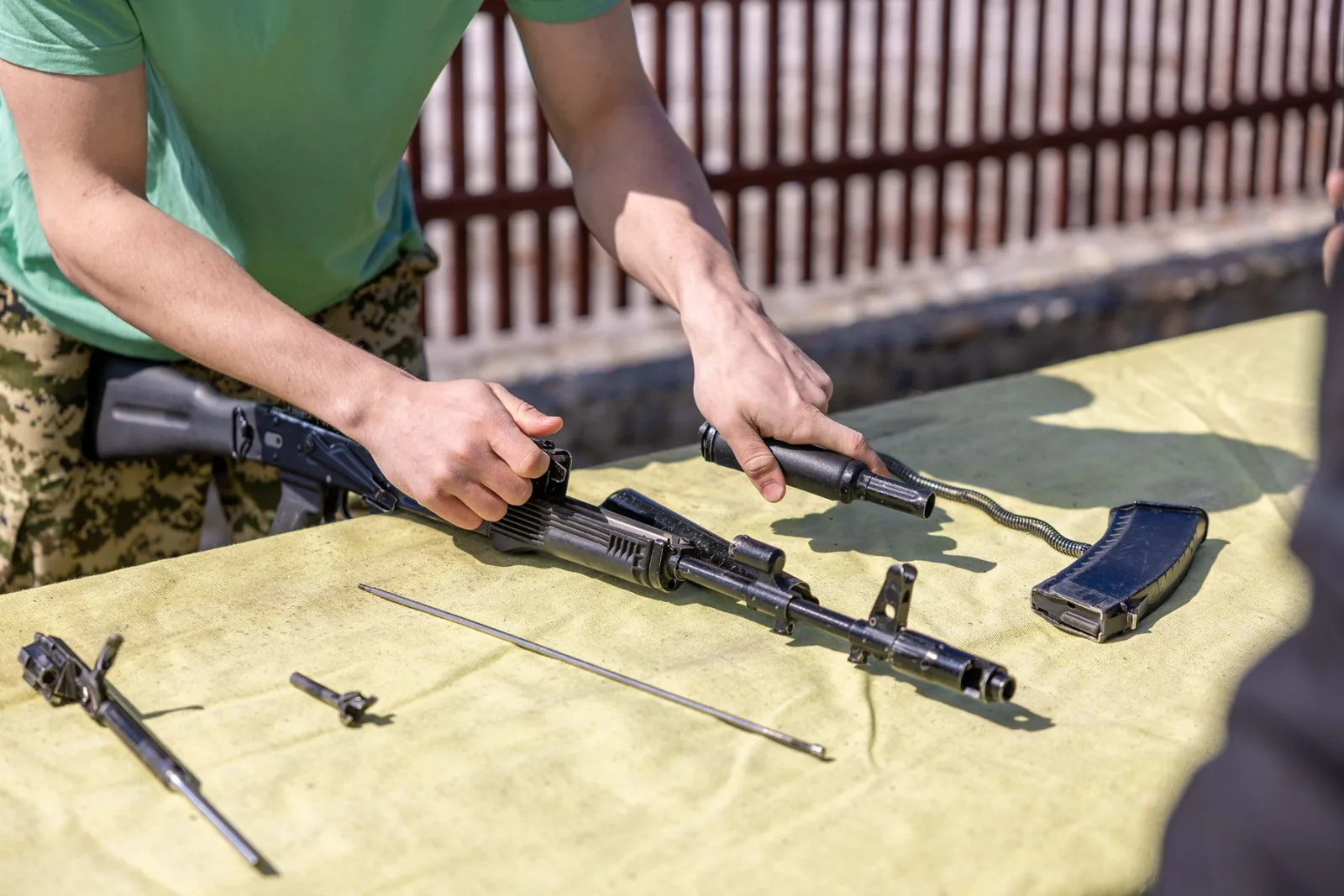
Ask ten shooters how often to clean a rifle barrel and you will hear ten confident answers: every session, every hundred rounds, never until it stops grouping. None of them is a law. There is no universal round count, because barrels, bullets, cartridges and goals differ. What you can do is learn what fouling does to your rifle and build an interval from your own records.
Carbon fouling versus copper fouling
Two kinds of deposit build up in a bore, and they behave differently. Carbon (powder residue) is a hard, gritty layer that collects mostly near the throat. Copper is a smeared layer of jacket material that fills the microscopic tool marks in the bore, and it can stack up gradually or in patches depending on the barrel’s finish. The gun barrel article gives the background on how rifling and bore surface fit together.
Which matters more depends on the rifle. Some barrels foul with copper readily and shoot best once a thin layer is back. Others foul very little.
Clean bore versus fouled bore
A freshly cleaned barrel is a different instrument from one that has fired a few dozen rounds. The first shots out of a clean bore often land away from where the rifle settles. Many shooters fire a few fouling shots after a cleaning, and how many it takes is specific to the barrel. That is why the shift people call cold bore shift is often a clean-bore effect in disguise, as covered in the cold bore shift article.
Think of the fouled state as the condition your rifle actually shoots in. Clean before every outing and you start each session unsettled. Never clean and buildup eventually degrades the bore. The right interval sits between those, and it is why any honest answer to how often to clean a rifle barrel includes how many fouling shots you are willing to spend.
Signs a barrel needs cleaning
When deciding how often to clean a rifle barrel, these signals are worth watching. All are things you can observe, and none is conclusive alone:
- Groups opening up gradually. A rifle that shot tight and slowly wanders over several sessions, with nothing else changed, is the classic sign.
- Velocity drifting. A trend in average velocity or a widening spread can follow bore condition. Compare it with your usual SD range first.
- Changing point of impact. A shift that tracks round count rather than weather suggests the bore is changing.
- Visible fouling. Copper streaking or heavy carbon at the muzzle or in the first inch of the bore, when you look with a bore light or borescope.
- Harder cleaning than before. Patches that come out dirtier and slower to clear suggest the interval has stretched.
Beware small samples: one wide group is not a symptom. A pattern over several sessions is.
How often to clean a rifle barrel: build your own interval
Deciding how often to clean a rifle barrel is an experiment: record, compare, change one thing. Track these against the barrel’s round count:
- Rounds fired since the last cleaning, noted at every session.
- Group size or mean radius for a standard string at a fixed distance.
- Average velocity and SD for the same string.
- The first-shot position relative to the group after cleaning, which shows how many fouling shots your barrel needs.
After a few cycles you can see where performance starts to slip and where it is stable. Your interval sits before the slip begins. If groups stay flat from fifty rounds to two hundred, cleaning at fifty was probably unnecessary for that rifle. If they fall off at seventy, you have a number from the barrel in your hands.
Change only the cleaning interval during this exercise. Change several things at once and you will not know which moved the numbers.
The risks of over-cleaning
Cleaning is not free, and over-cleaning is the quiet cost of answering “always”. Every pass of a rod and brush has a chance of damaging the crown, the throat or the bore surface, and a rod pushed through from the muzzle can wear the crown over time. Harsh solvents and abrasives can strip a layer the rifle shoots well with, and solvent or oil left in the bore changes the first shots. Use a guide, a quality rod and correctly sized patches or brushes, and follow the barrel maker’s advice.
Break-in procedures carry the same folklore. The barrel break-in article looks at what is actually known.
Competition rifles versus hunting rifles
Use shapes the answer. A match rifle shot daily has tight records, so small drift is visible, and many competitors clean on a round count validated for that barrel. A hunting rifle that fires a handful of rounds a season has a different problem: the first shot matters. Confirm zero and first-shot behavior in the state you will carry it, clean and dry or fouled, rather than assuming.
The answer to how often to clean a rifle barrel differs for each. Neither profile is right or wrong. What differs is how much data you have and what a small shift costs.
Cleaning is not the same as barrel life
Cleaning is only one factor in barrel health. Throat erosion is a separate, slower process that cleaning cannot reverse, and it eventually sets the barrel’s accuracy life. The guide on how to track throat erosion shows how to measure it from your own seating data.
The smart answer
So how often to clean a rifle barrel? As rarely as your data allows, and as often as it demands. Count rounds, watch group size and velocity across sessions, learn how many fouling shots your barrel wants, and clean when the trend, not the calendar, says so. A number you measured yourself beats any rule you inherited.
In LoadNode, each barrel tracks rounds fired. If you set an accuracy life, it shows the percentage used, orange at 80 percent and red at 100 percent, plus the best group and best SD for that barrel. Multi-barrel profiles (Pro) keep several barrels on one firearm apart, and a throat erosion chart (Pro) plots jam (CBTO) measurements over time. There is no dedicated cleaning log, so note each cleaning in the session notes and line it up with the round count later.
Handloading is an adult activity done at your own risk. LoadNode is a logbook and analysis tool: it never provides load data. Always develop loads from current published manufacturer data and work up safely.