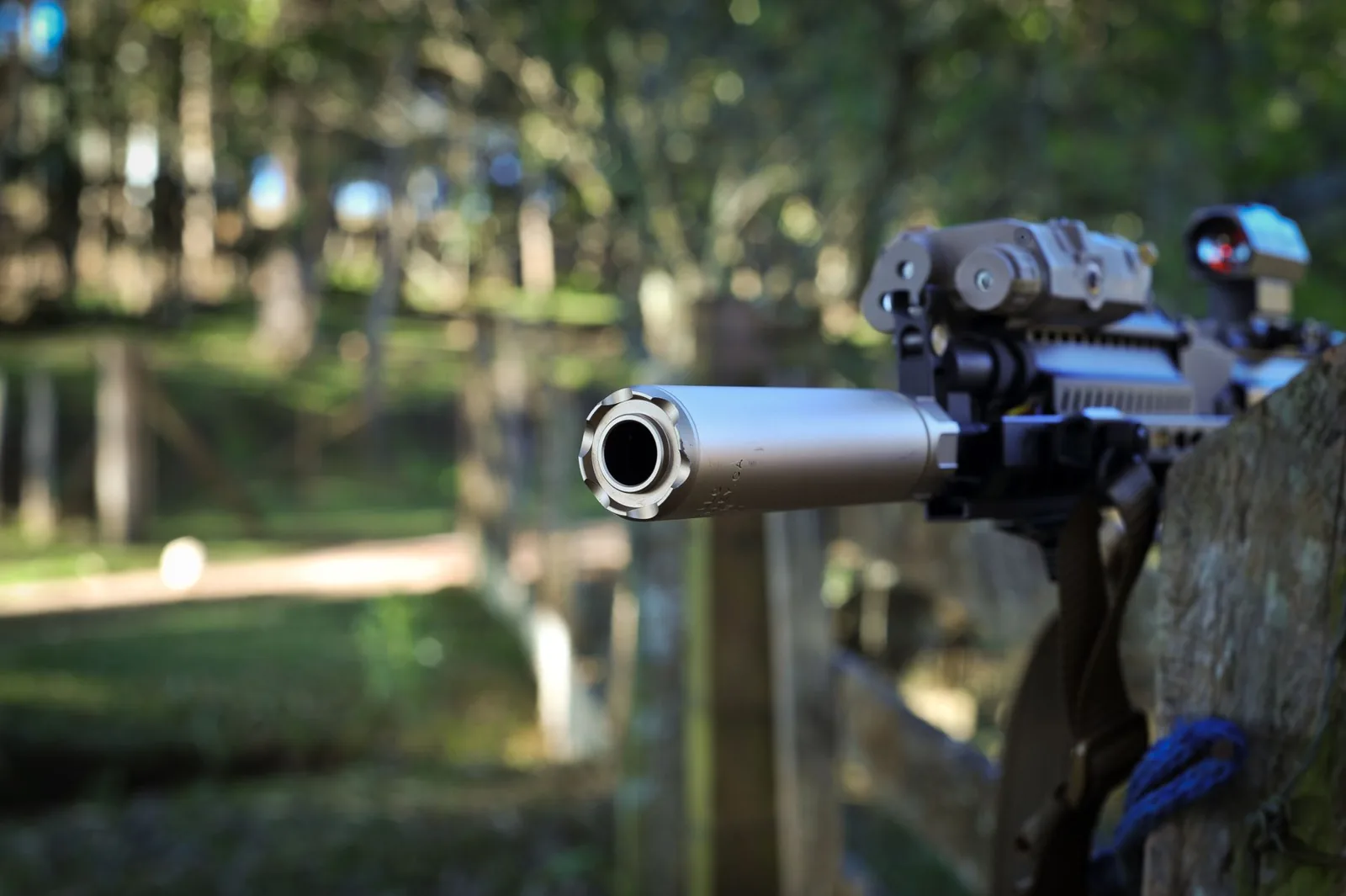
Screw a suppressor onto a rifle that was zeroed bare and the first group often lands somewhere new. Sometimes it is a fraction of a minute of angle, sometimes a few inches at a hundred yards. This suppressor poi shift is a common surprise for new can owners, and it is poorly understood because the cause is rarely one thing. Here is what is going on, and how to measure it on your own rifle instead of trusting a forum rule of thumb.
Why a suppressor can move your point of impact
A suppressor is a mass hanging off the end of a barrel, and a barrel is a springy rod that whips and settles as the bullet leaves. Adding or removing weight at the muzzle changes that motion, and the barrel’s state at the instant of exit helps decide where the bullet goes. Several separate effects can stack up:
- Barrel harmonics. The extra mass changes the vibration pattern, so the exit angle can differ from a bare muzzle.
- Muzzle pressure and velocity. A can briefly raises pressure at the muzzle, and many shooters see a small change in measured velocity. Size and direction vary by rifle, cartridge and can.
- Mount repeatability. Direct-thread, quick-detach and piston-style mounts each seat differently. A mount that returns to a slightly different position every time produces a shift that looks random.
- Alignment. A can that is not concentric with the bore is a safety problem first and an accuracy problem second.
- Heat. A hot can behaves differently from a cold one, and it creates mirage in front of the scope.
Because the mechanisms differ, there is no universal direction or size for the shift, and two identical rifles with the same can may disagree. The overview of firearm suppressors covers how these devices work. The only reliable answer for your rifle is your own data.
Zero for the configuration you will shoot
The practical rule is simple: zero in the configuration you will use. If the can lives on the rifle, zero suppressed. If you swap, treat bare and suppressed as two setups and record the offset between them from measured groups, not memory.
Any suppressor poi shift is an angular error, so it grows with distance. After a configuration change, confirm your drop at range using the process in how to true a ballistic calculator.
How to measure suppressor poi shift properly
A fair test of suppressor poi shift needs a controlled comparison, because one group each way tells you almost nothing. Scatter inside one five-shot group is large, and the shift you are chasing may be smaller.
- Shoot both configurations on the same day, at the same distance, in similar light and wind. A shift measured across two days includes everything that changed in between.
- Alternate configurations instead of finishing one and then the other. Heat, fouling and fatigue drift through a session, and alternating spreads that drift across both.
- Fire enough shots per configuration. The distance between the centers of two small groups is itself noisy, so more shots, or several pooled groups, narrow it.
- Label every group with its configuration the moment you shoot it.
- Compare group centers, not the farthest holes. The offset between centers is the shift; the spread inside each group is a separate question about precision.
Read every target the same way. The steps in how to read a target and how to measure group size in MOA keep that consistent.
Do not mix suppressed and bare data
The most common mistake when tracking suppressor poi shift is pooling everything into one record. Suppressed and bare strings are different populations. If a load seems to have opened up, you need to know which configuration each shot came from before deciding whether the load changed or the setup did.
The same goes for velocity. Because a can can change muzzle velocity, keep suppressed and bare averages as separate datasets. The basics in how to use a chronograph still hold, with one extra step: note the configuration on every string.
Heat, mirage and cold-can behavior
A suppressor heats up fast, and heat rising off it produces mirage right in front of the scope, enough on a long string to move your aim point. Let the can cool between groups, or keep your cadence the same for both.
The first shot from a cool can may also differ from the shots after it, much like any cold-barrel effect. If you cannot tell a can issue from a barrel issue, cold bore shift explains how to separate them with first-shot records.
Chronographs and cans: radar versus optical
An optical chronograph reads the bullet passing over its sensors, and a can’s blast and flash can behave differently from a bare muzzle. A Doppler radar unit sits beside the muzzle and tracks the bullet itself, which many shooters prefer with a suppressor. Either way, place the unit consistently. A string that drops shots or shows a clearly wrong velocity usually points at the instrument or its placement, not the rifle.
Keeping the record straight in LoadNode
Every firearm in LoadNode has a Gear screen where you list optics and suppressors, with manufacturer, model, mount, weight and notes, and you can mark one as fitted. When you create a session, the wizard asks about the suppressor: pick a can, choose “Suppressed”, or choose “None”, and the session keeps that choice. The parts and setup list per firearm (Pro) is copied into each new session and warns you when the firearm has changed since, which catches a swapped can or mount.
Point-of-impact offset is measured from the target photo, so you can quantify suppressor poi shift as a center-to-center number, not an eyeball guess. Compare sessions (Pro) notes when conditions differed, so a suppressed morning is not quietly compared with a bare afternoon.
The honest conclusion
No rule tells you which way a can will move your rifle. Suppressor poi shift is real on many rifles, absent on some and unstable on a few, and the cause is usually a mix of harmonics, mount repeatability and heat. Zero for the configuration you shoot, test both setups the same day with enough shots, keep the data separate, and let your own measured offset decide. Small samples mislead, so if the number wanders, shoot more first.
LoadNode keeps the configuration, target photo and offset in one logbook, so the next suppressor poi shift test starts with the last one already on file. It never tells you what to load.
Handloading is an adult activity done at your own risk. LoadNode is a logbook and analysis tool: it never provides load data. Always develop loads from current published manufacturer data and work up safely.