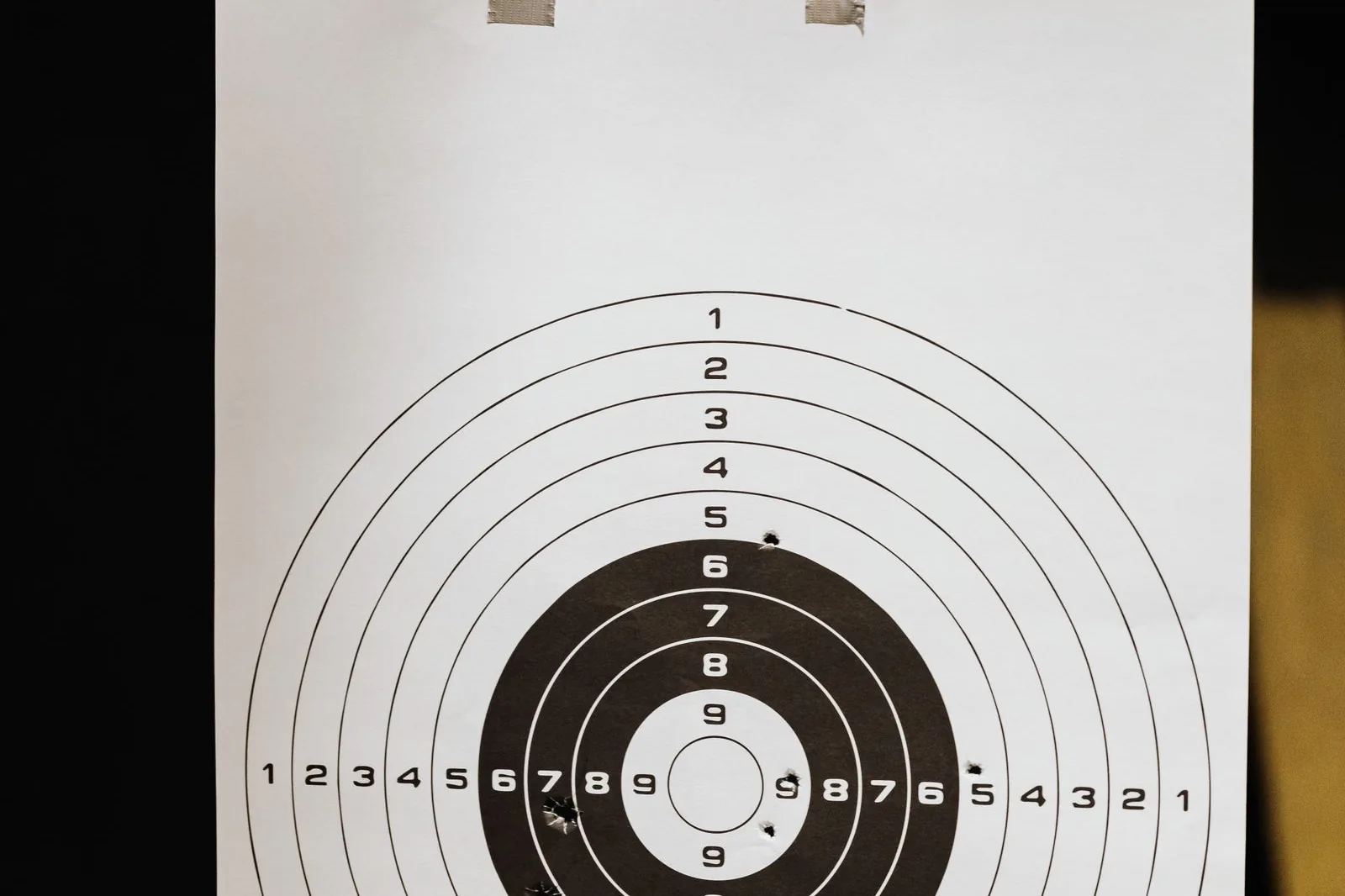
Ask a room full of precision shooters how many shots for load development they fire before committing to a load, and most will say three, or five if they are feeling generous. That number did not come from statistics. It came from habit, from saving barrel life, and from the fact that a neat three shot cluster is satisfying. Small groups are a noisy way to measure precision, and a noisy measurement will rank your loads in the wrong order without telling you it has done so.
Group size is a weak statistic, and here is why
When you measure a group as extreme spread, centre to centre between the two furthest holes, you throw away almost everything the target told you. A five shot group is measured by two shots. The other three could sit anywhere inside that envelope without changing the number, so the statistic you report is built from the two most extreme holes, which are exactly the shots most affected by luck.
Extreme spread also has a large variance of its own. Fire the same load, from the same rifle, in the same conditions ten times over, and the group sizes will scatter far more than most shooters expect. That scatter is not the load changing. It is the measurement being unreliable. When one load prints tight and another prints wide, you may only have learned which got luckier.
Why how many shots for load development has no single answer
The honest answer to how many shots for load development depends on how big a difference you are trying to detect. A large difference is cheap to find. If one load is genuinely twice as precise as another, a modest number of rounds will usually show it. A small difference is expensive, and it gets dramatically more expensive as the difference shrinks. The improvements handloaders actually chase, the last fraction of a minute, sit deep in the territory that needs far more rounds than most people are willing to shoot.
This cuts both ways, and the second direction gets ignored. A small sample can make two identical loads look different, sending you after a phantom. It can also make two genuinely different loads look identical, so you discard a real improvement because one group did not cooperate. Both errors feel like data.
Pool your groups instead of hunting for a magic number
The way out is to stop thinking in single groups and think in totals. Rather than asking how many shots for load development belong in one group, ask how many you have accumulated on that load overall. Several groups of the same load, fired across different days and pooled into a twenty to fifty shot picture, tells you far more than one staged group of ten. Pooling averages out the wind you misread and the day you shot badly.
That changes how you test. If a meaningful sample costs that many rounds, testing eight variables badly is worse than testing two properly. Barrel life is the real constraint, and rounds spent on underpowered comparisons are rounds you do not get back. Narrow the question first, then spend the barrel answering it. It is worth understanding a structured approach such as a ladder test compared against an OCW style test before you start burning rounds.
The same problem lives in your velocity data
Standard deviation behaves exactly like group size. An SD from a three shot string is close to meaningless: it carries two degrees of freedom and swings wildly between strings of the same ammunition. Ten shots is a starting point, more is better, and pooling strings is again the cheapest way there. Our piece on what counts as a good SD for reloading covers what those numbers mean downrange, and the same caution applies to identifying a velocity node: a flat spot found in a handful of shots may not survive a larger sample.
Record enough that groups can be pooled later
Pooling only works if the groups are comparable, and that depends on what you wrote down at the time. A group fired with a new lot of primers is not the same experiment, even if the load is nominally identical.
- Rifle, barrel and total barrel round count
- Every component lot, not just the component
- Date, temperature and wind conditions
- Position, rest and whether the barrel was fouled
- The full shot by shot velocity string, not just the summary
This is the boring half of the discipline, and it is the half that makes the interesting half possible. Groups scattered across notebooks, photos and memory can never be pooled, which is the whole reason to keep them in one logbook such as LoadNode.
Mean radius gets more out of the same rounds
If barrel life is the constraint, extract more information from each shot. Mean radius, the average distance of each hole from the group centre, uses every shot rather than two. That makes it more stable than extreme spread, so it converges on the truth with fewer rounds fired. It does not remove the need for a decent sample, but it improves the exchange rate between barrel life and confidence. We compared them in mean radius versus group size, and the measurement work published at PrecisionRifleBlog is worth reading for the wider background.
What to do on Saturday morning
None of this makes load development pointless. It means how many shots for load development you need is a question about how much confidence you are buying, and at what price in barrel life. Test fewer variables. Fire more rounds on each. Pool everything you fire on a given load, log it in enough detail that pooling is possible months later, and treat any conclusion from one small group as a hypothesis rather than a result.
The shooters who get the most out of a barrel are rarely the ones testing the most combinations. They are the ones who asked how many shots for load development a real answer requires, accepted that the number is larger than they hoped, and spent their rounds accordingly.
Handloading is an adult activity done at your own risk. LoadNode is a logbook and analysis tool: it never provides load data. Always develop loads from current published manufacturer data and work up safely.