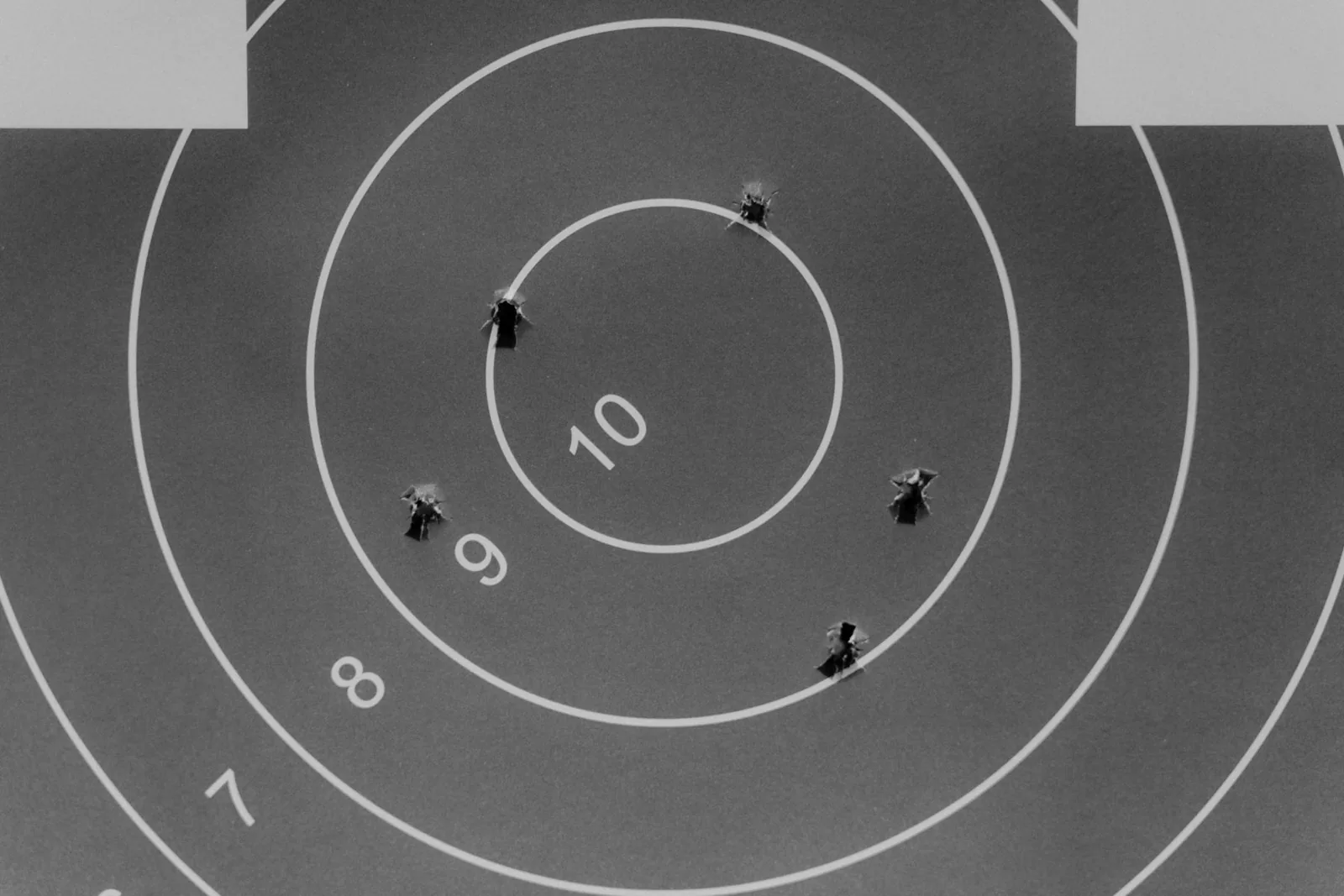
Most shooters grade a group with one number: the distance between the two holes farthest apart. It is quick, and it is a poor summary, because every other shot on the paper is ignored. CEP shooting borrows a better habit from artillery and missile testing, where nobody could afford to judge a weapon by its two worst rounds. It describes the whole pattern with a radius that uses every impact, and it is honest about how little a small sample can tell you.
What CEP and R50 actually mean
CEP stands for circular error probable. Draw a circle centered on the middle of your impacts, sized so that half of the shots land inside it. The radius of that circle is the CEP. On a rifle target it is usually called R50, the radius containing 50 percent of shots. R95 is the same idea at 95 percent: the circle that holds nineteen shots in twenty. The measure comes from ballistics and guided weapons, where it describes how closely a weapon lands to its aim point; see circular error probable.
Because the circle is centered on the group, CEP shooting measures dispersion, not accuracy in the sense of hitting the point you aimed at. Where the center sits relative to your aim point is a separate measurement.
Why every shot matters more than the extremes
Extreme spread depends on two shots. Add shots to a group and it can only stay the same or grow, which is why a ten shot group looks worse than a three shot group from the same rifle, and why comparing group sizes across different shot counts is meaningless. CEP shooting statistics use every hole, so they settle down much faster as shots accumulate. The case is made in mean radius versus group size, and mean radius is closely related to R50: for a round, evenly spread pattern the mean radius sits a little above the R50, pulled up by the far shots that R50 ignores.
CEP shooting and the shape of a real group
For a pattern spread equally in all directions and following a normal distribution, the numbers have fixed relationships. R50 is about 1.18 times the standard deviation in each direction, R95 is about 2.45 times it, and so R95 is roughly twice R50. If your R95 is far more than double your R50, suspect a few wild shots, a pulled round, or a pattern that is not round.
Real rifle groups are often taller than wide, or the reverse, from vertical stringing, bedding or wind. A single circle hides that, and vertical and horizontal spread read separately tell you more about what is wrong. For the basics of reading those patterns, see how to read a target.
Small samples understate spread in CEP shooting
This is the part most people skip. A five shot group is a small sample of everything the rifle and load can do. Shots that land at the edge of the true pattern are rare, so in five rounds you probably did not see them. Small groups therefore understate the real spread, and a lucky one is tempting to believe. Centering on the sample’s own middle adds a second small bias in the same direction.
R95 is the hardest to trust. Estimating a 95th percentile from five or ten shots amounts to reporting the farthest shot and calling it a probability. You need a few dozen shots before an empirical R95 means anything, and even then it is a noisy number. R50 behaves better, since it only needs the middle of the distribution, but it still wanders below about twenty shots. The same trade between cost and confidence runs through how many shots for load development.
Pooling small groups into a usable sample
Few people want to fire fifty rounds through a precision barrel in one sitting. The practical answer in CEP shooting is to pool several small groups. The step that makes this legitimate is re-centering: move each group so that its own center sits at the origin, then overlay them. This removes the drift between strings, which comes from your zero, the wind and the day, and keeps only the dispersion inside each group. Five groups of five become one sample of twenty-five radii.
Only combine groups fired under the same conditions with the same load, and keep the wander between group centers as its own figure, because a rifle whose groups are small but scattered across the paper has a different problem from one whose groups are large.
Reading R50 and R95 as a floor, not a promise
A measured R50 describes what happened on the days you shot, not what the next group will do. In a match or on a hunt you face wind you did not log, a cold barrel and a tired shooter, all of which add spread your range data never contained. Treat pooled CEP shooting statistics as the best this rifle and load has shown under good conditions, a floor rather than a prediction, and read the interval around an estimate as closely as the estimate.
When you convert any radius to angular units, do it the same way every time. See how to measure group size in MOA for the method, which matters when you compare targets shot at different distances.
A practical routine
- Fire strings of the same size under the same conditions, and record the load, distance and date for each.
- Mark every impact on a photo of the target with a known scale.
- Re-center each group on its own middle before comparing or pooling.
- Read R50 first, treat R95 with caution until the sample is large, and report the shot count with every number.
In CEP shooting terms, the aim is to replace a gut feeling about a lucky group with a number you can defend, and to know how much that number could move.
How LoadNode helps
LoadNode does this pooling for you with composite groups, a Pro feature. It combines every measured group in a scope you choose, whether one charge, this session or the whole recipe across sessions. Each group is re-centered on its own center first. It then reports a corrected mean radius with a 95 percent interval, R50 and R95 read straight from your own shots rather than from a fitted model, vertical and horizontal sigmas, and the wander between groups as a separate figure. It never names a winning charge. A group needs a range and at least two marked impacts to be pooled.
Handloading is an adult activity done at your own risk. LoadNode is a logbook and analysis tool: it never provides load data. Always develop loads from current published manufacturer data and work up safely.