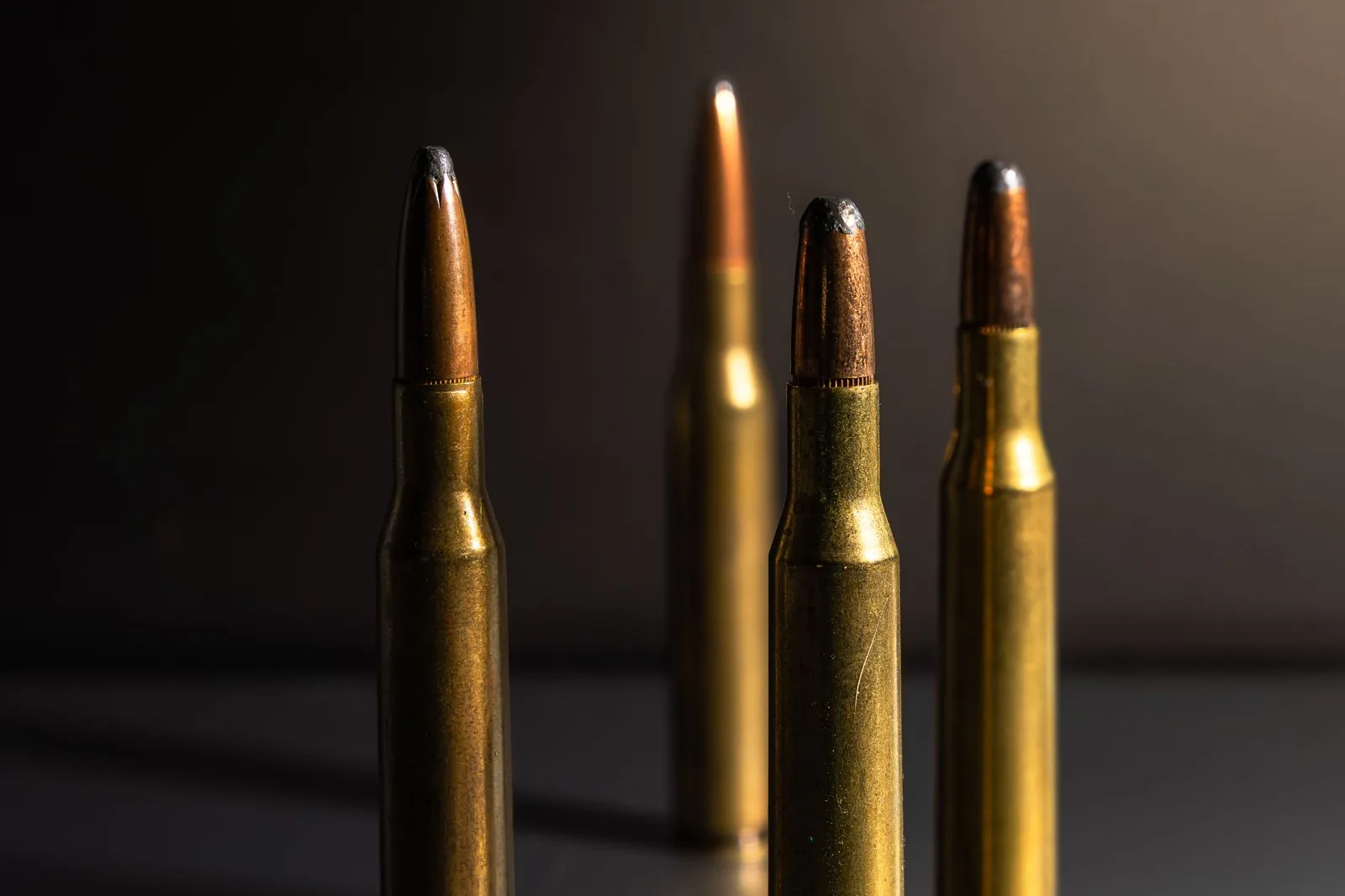
Ask ten precision shooters about bullet runout and you will get ten different answers, from “it is the first thing I check” to “it is a solution looking for a problem”. Both camps have data on their side, which is why the topic refuses to die. Runout, or concentricity, measures how far the bullet sits off the centreline of the case body. It is easy to measure, easy to obsess over, and hard to prove matters at the small values most handloaders actually produce.
What the number actually describes
The figure people quote is total indicated runout, or TIR. You spin the loaded cartridge on a concentricity gauge, supported on the case body, and watch a dial indicator riding on the bullet. TIR is the full sweep of the needle over one rotation, so it is roughly twice the actual offset from the axis. A round reading 0.003in TIR sits about 0.0015in off centre. That distinction matters when comparing numbers with other shooters, since plenty quote one and mean the other.
Where you put the indicator changes the number too. Measured near the tip you will always read more than at the ogive, because tip variation adds in, and meplat concentricity has nothing to do with how the bullet enters the rifling. The ogive touches the lands, so that is where a useful measurement is taken. Reading on the case neck instead tells you about your sizing and case prep, which is separate and arguably more useful information.
What causes bullet runout
Almost every source of crooked ammunition is an alignment problem. The usual suspects:
- Uneven neck wall thickness. If one side of the neck is thicker, it pushes the bullet off axis as it grips.
- Sizing die alignment. A die that is not square to the ram, or a press with slop in the linkage, sizes the case slightly bent.
- The expander ball. Dragging a ball back up through the neck can pull it sideways, especially with dry or tight necks.
- Seating die alignment. If the stem contacts the ogive off centre, the bullet starts tilted and stays that way.
- Case shape. Brass that chambered crooked in a generous chamber comes out with the neck already offset from the body.
Most of these are the same faults that cause uneven grip on the bullet, which is why the subject is hard to test cleanly.
Does bullet runout show on target
Here is the honest position: the published evidence is mixed. Several well known tests, including work reported by benchrest shooters and the technical writers at the AccurateShooter Daily Bulletin, have deliberately sorted ammunition into straight and crooked lots and shot them side by side. A number of those tests found no clear difference at the levels most handloaders see, roughly under three or four thousandths TIR. Others, using exaggerated runout well beyond what normal dies produce, did show groups opening up. Both results can be true at once: the effect may be real but small enough to disappear under everything else in the shooting system.
There is a physical argument for a small effect too. In a rifle with a reasonable throat, a tilted bullet is partly straightened as it is pushed into the rifling, particularly when seated close to the lands. That does not make the effect zero, but it caps how much damage a couple of thousandths can plausibly do.
The sample size problem
The real obstacle to settling the argument is statistics. Group size is a noisy measurement. Detecting a fraction of a tenth MOA between two lots, with any confidence, takes far more rounds than almost anyone shoots: not two groups of five, but dozens per condition. Most runout tests you read online, including the ones supporting your favourite conclusion, are underpowered. A metric using every shot, discussed in our note on mean radius versus group size, is more informative than extreme spread when you are chasing small effects. Even then, be realistic about what your barrel life will support.
Reduce it as a by-product, not as a goal
The practical resolution is that nearly everything which lowers bullet runout is worth doing for other reasons anyway. Checking neck wall thickness, keeping necks clean and lightly lubricated inside, using an expander mandrel rather than a ball, and a seater that supports the case before the bullet starts all improve consistency of grip and release. Those are the same practices covered in brass prep for accuracy and in the discussion of neck tension and bushing dies. If your numbers fall as a side effect, treat that as a symptom of a tidier process rather than the prize itself.
What the gauge is genuinely good for is diagnosis. A sudden jump in bullet runout across a batch usually means something changed: a die backed off, a worn expander, or a case lot with different neck thickness. Logging the reading alongside the rest of your load record, which is the kind of thing LoadNode is built to keep together, turns a single number into a trend you can act on.
When to stop chasing bullet runout
Set a threshold you can defend and then leave it alone. Many shooters cull anything over about 0.003in and load the rest, a reasonable compromise given how thin the evidence is for finer distinctions. If a large share of your rounds fail that check, the fix is upstream in your sizing and seating, not in sorting finished ammunition. It is worth asking whether your sizing method contributes, part of the trade-off in full length versus neck sizing.
Going below a couple of thousandths is unlikely to be what stands between you and a smaller group. Wind reading, position, velocity consistency and rifle setup sit ahead of it. But dismissing runout entirely is not supported either. Measure it, keep it inside a sane limit, understand what a change in the number says about your process, and spend the rest of your effort elsewhere.
Handloading is an adult activity done at your own risk. LoadNode is a logbook and analysis tool: it never provides load data. Always develop loads from current published manufacturer data and work up safely.