Few debates start more arguments at the loading bench than MOA vs MIL: and almost all of the heat is misplaced. Neither unit is more accurate, more “tactical,” or more correct. They are just two rulers for measuring angle. What actually matters in the MOA vs MIL question is that your turrets, your reticle and your brain all speak the same language. This guide gives you the exact numbers, the real trade-offs, and a clear way to choose.
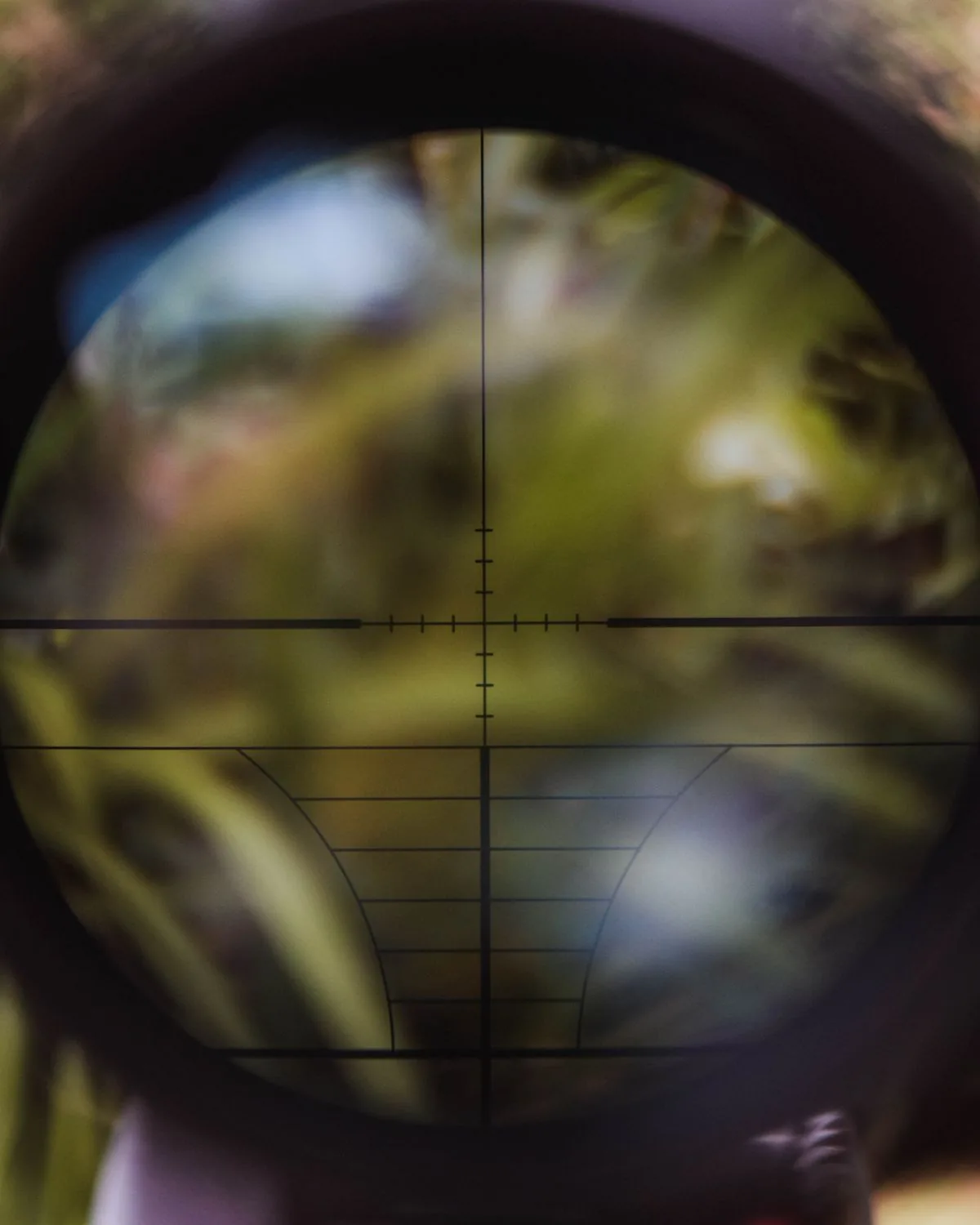
What MOA and MIL each are
MOA (minute of angle) is one-sixtieth of a degree. At 100 yards it subtends 1.047 inches: close to an inch, which is where the “inch at 100” shorthand comes from. Most MOA scopes adjust in 1/4 MOA clicks (about 0.26″ at 100 yards).
A MIL (milliradian, or mrad) is one-thousandth of a radian. At 100 yards it subtends 3.6 inches, or a tidy 10 cm at 100 meters. Most MIL scopes adjust in 0.1 MIL clicks (about 0.36″ at 100 yards). If you want the underlying geometry, here is the definition of a milliradian.
MOA vs MIL: the conversions
The one number that settles most MOA vs MIL confusion: 1 MIL = 3.438 MOA. So a 0.1 MIL click (0.36″ at 100 yd) is a hair coarser than a 1/4 MOA click (0.26″). In practice both are far finer than any rifle’s dispersion, so the “which is more precise” argument is a wash for real shooting.
| Unit | At 100 yd | Common click | Click at 100 yd |
|---|---|---|---|
| 1 MOA | 1.047 in | 1/4 MOA | ~0.26 in |
| 1 MIL | 3.6 in | 0.1 MIL | ~0.36 in |
The only rule that matters: match your turrets to your reticle
The single biggest MOA vs MIL mistake is a scope with a MIL reticle and MOA turrets (or vice versa). When they mismatch, you cannot see a miss in the reticle and dial the correction directly: you have to convert mid-string, which is how hits get dropped. Whichever you choose, make sure the reticle subtensions and the turret clicks are the same unit.
Spotting and correcting is faster in one unit
Here is where the MOA vs MIL choice pays off in the real world. Say your spotter sees your miss land two marks left of the target in the reticle. If your reticle and turret are the same unit, you simply dial or hold that same two marks right: no conversion, no delay. This is why the MOA vs MIL decision is really a decision about friction: any time your eye measures an error in the glass and your hand corrects it on the turret, matching units removes a step. In a timed stage or on a moving animal, that saved second is the difference between a hit and a story about the one that got away.
So which should you pick?
- Choose MIL if you shoot with others (PRS/NRL and the military overwhelmingly speak mils, so spotter corrections are instant), like base-10 math, or think in metric.
- Choose MOA if you think in inches, want the slightly finer click, or already own MOA glass and know it cold.
There is no wrong answer in MOA vs MIL: only the wrong mixture. Pick one system, run it on both the reticle and the turret, and commit. For measuring your groups in either unit from a photo, see our guide on how to measure group size in MOA.
LoadNode reports your group size, mean radius and point-of-impact offset in whichever unit you prefer, MOA or MIL, so your logbook always matches the scope on your rifle. Pick the unit once in settings and every group you have already measured is re-reported that way, not just the next one. Settle the MOA vs MIL question once, then spend your energy on wind and fundamentals, where the real points are.
Handloading is an adult activity done at your own risk. LoadNode is a logbook and analysis tool: it never provides load data. Always develop loads from current published manufacturer data and work up safely.